
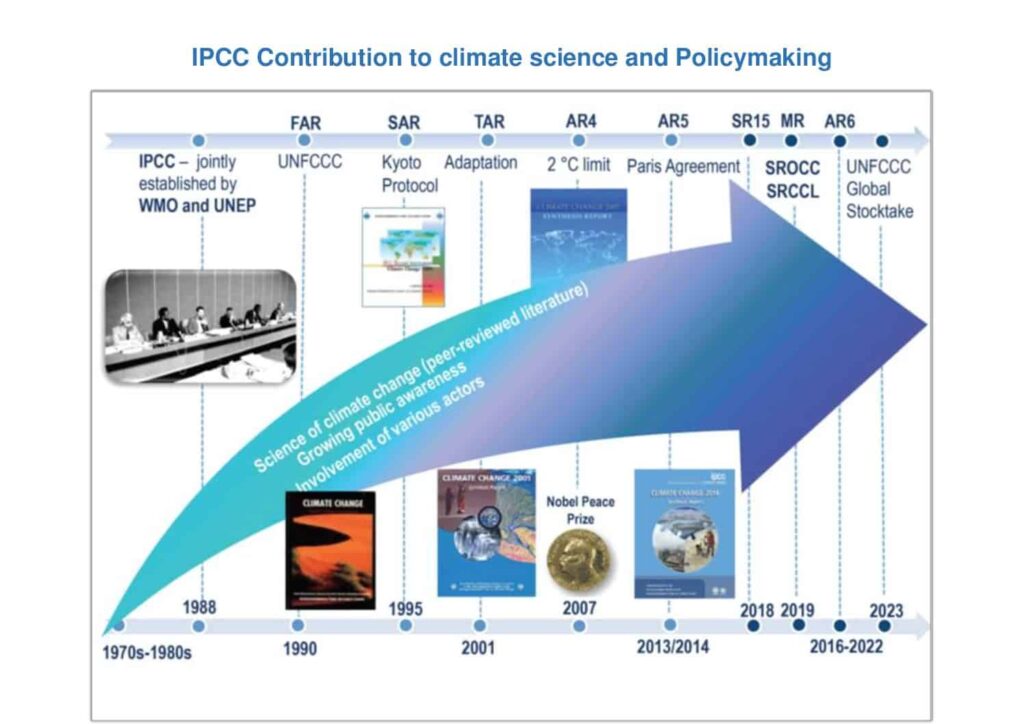
The quality of Climate related discussions, including consultations on Canada’s Climate action Plan, can be improved with more understanding of the mandate of the IPCC and the content of IPCC AR 6 Reports.
There’s a lot of climate news going on these days, and most of us have definitely heard about the IPCC and the series of reports on “what the science says”.
Maybe you heard something about their grim assessments. But you probably also thought “this doesn’t seem very fun to read”. It’s pretty dense science information.
For sure… those long reports have a bit of a marketing problem. Who wants to read… “the exciting and uplifting story about our narrowing window of opportunity to save the burning world??
When we take a closer look, we can see that the story is quite action-packed with collapsing ice sheets and melting permafrost, other tipping points and international intrigue. And, there are tiny slivers of good news around some technologies and approaches that can make a difference
In all of this there is a very serious story about how Canada needs to do a lot to stay caught up with responsibilities we have to eliminate our own emissions. To get specific, the measures in “Canada’s 2030 Emissions Reduction Plan” announcements are feeble window dressing compared to the substantial transformation that is really required.
THE IPCC
The IPCC (Inter-governmental Panel on Climate Change) Is the United Nations body for assessing climate change. It is the official science. The IPCC was created 1988 by the United Nations Environment Programme (UN Environment) and the World Meteorological Organization (WMO). There are 195 member countries represented in the three working groups and task forces
THE PURPOSE OF THEIR WORK
The purpose of their work is to tell us what the science agrees on about climate change. They basically have the job of going through the latest good information on science and explaining what it says.
Scientists from 195 members countries contribute content. Hundreds of studies are assessed. The extent of agreement among the scientists is noted. Summaries are pulled together.
It is important to pause on this point for a second.
It’s only been in the past decades that there was this ability for the scientific community to work across so many jurisdictions and languages, with such an amount of depth and variety of information. We are in a rare time of this amount of international coordination. The IPCC reports, give us the highest quality, most thorough expert analysis of the state of science on climate change that has ever existed.
This is a significant development. It’s Big stuff.
The reports note where there are new findings and where further study is needed.
HOW DO THEY DO THEIR WORK
Let’s look at who’s involved in the IPCC reports and look at how do they do their work.
The IPCC organization sends a call to governments for nominations and detailed resumes are collected. Team members are selected based on their expertise, technical, and geographic backgrounds. These selected scientists volunteer to review and summarize the latest scientific information on climate. There were hundreds of scientists from around the world involved in the recent around of IPCC work.
This includes dozens of Canadian scientists. There were 28 Canadians contributing to the last cycle of reports.
STRUCTURED REPORTING
The IPCC work is structured into numbered Assessment Reports and associated Working Group reports (they also have other special reports).
We can use AR and WG for short. The IPCC prepares the AR reports on the knowledge on climate change, its causes, potential impacts and response options.
There are THREE working groups:
- Working Group I deals with The Physical Science BASIS of Climate Change
- Working Group II with Climate Change IMPACTS, Adaptation and Vulnerability
- Working Group III with MITIGATION of Climate Change.
This is quite a large and unusual collaboration that’s been going on for a number of years. The reports build on prior reports so we can see that the certainty and the consensus continues to improve. The RESULT is an internationally recognized consensus summary of the state of science on climate change prepared by the world’s leading experts.
THE SIXTH ASSESSMENT REPORT
This year, 2022, is a big year for the IPCC reporting. AR 6 involves the work of 743 experts. The THREE working group reports form AR6 are now published and available on the IPCC website. (the link is in the description).
For starters, It’s not the case that these reports are all DOOM and GLOOM. it’s just mostly doom and gloom with little flecks of optimistic findings scattered about!
AR 6 has 18 chapters and, together, there are thousands of pages. At first blush, it sounds like something only specialists would read. EACH of the Working Group reports have shorter format Summaries for Policy Makers. These are a manageable read.
In this story, WE are the Policy Makers
Broadly speaking the Summary includes: A high level note on the science and approach for the report; Key Findings statements along with notes about the extent of agreement (or confidence level); Also – different scenarios or pathways are laid out and put against a number of outcomes. This is a way of describing the different projections. For example, in a scenario where we continue to have lots of CO2 emissions, what does the science tell us it will do to storm intensity or sea level rise?
The scientists review the available research and make a projections they agree on in the report)
AR6 WG1 THE PHYSICAL BASIS
Let’s take a look at some highlights from AR6 WG1 Report
The Working Group I contribution to the AR6 addresses the most up-to-date physical UNDERSTANDING of the climate system and climate change.
There are dozens of findings in the report.I’ve highlighted just THREE
- 1: It is unequivocal that human influence has warmed the atmosphere, ocean and land. Widespread and rapid changes in the atmosphere, ocean, cryosphere and biosphere have occurred.
- 3: Human Induced climate change is already affecting every inhabited region across the globe, with human influence contributing to many observed changes in weather and climate extremes
- 1: Global surface temperature will continue to increase until at least mid-century under all emissions scenarios considered. Global warming of 1.5°C and 2°C will be exceeded during the 21st century unless deep reductions in CO2 and other greenhouse gas emissions occur in the coming decades
<<<<<GRAPHIC >>>>> SEE graph on pg 6 AND use CHART on pg 13
You’ll see on this graph, the detail around the relationship between CO2 emissions and global temperatures. We know that there is high agreement among scientists- that Human influence has warmed the climate at a faster rate than anytime in the last 2000 years.
This next graphic takes into account some modelling developed in earlier reports.
They put together FIVE illustrative scenarios that cover the range of possible futures based on research. The scenarios with higher emissions will have different impacts on global weather conditions.
The scientists all agree, the more CO2, the worse things get.
It goes a bit further to assess the play of negative feedback loops.
The scenarios associated with higher emissions, there is a decreasing ability for natural carbon sinks to absorb CO2.
With more CO2 staying in the atmosphere, the weather gets worse and… then A LOT WORSE. (not just linear but curvilinear)
AR6 WG2 Impacts, Adaptation and Vulnerability
Let’s take a quick look at that AR6 WG2 report:
The Working Group II contribution to the AR6 assesses the IMPACTS of climate change, looking at ecosystems, biodiversity, and human communities at global and regional levels. It also reviews vulnerabilities and the capacities of the natural world and society to adapt.
There are couple of highlights to share from the WG2 report.
SPM.B.5 Climate change impacts and risks are becoming increasingly complex and more difficult to manage. There are Multiple climate hazards; compounding overall risk across all sectors. (high confidence)
GOOD NEWS??
There are a group of findings that show some good news.
For example, C.1 say… the Progress in adaptation planning and implementation has been observed across all sectors and regions, generating multiple benefits
(That comment refers to the whole world and it has very high confidence).
That is really good news. But they do mention later that the progress is uneven and there’s too much focus on near-term solutions instead of long-term transformation.
<<<<<<SHOW CHART – DIVERSE FEASIBLE CLIMATE RESPONSES
C.2 There are feasible and effective adaptation options which can reduce risks to people and nature.
They add that the feasibility of these differs across sectors and regions and they also say that effectiveness of strategies will decrease and the weather changes.
This is the good news. But, as usually with climate change, the drama and urgency is still with us.
You can see in this chart they explain the narrowing window of opportunity for us to respond.
This is a bit of a nudge for all of us to judge whether or not Canada is doing everything it can to transition from fossil fuels and use new technologies.
The multi-year plan includes over $100 billion committed by our government to climate and green economy investments and more than one hundred different measures.
They say, this first Emissions Reduction Plan charts a credible path to emissions that are 40 percent lower than 2005 levels by 2030. This is an evergreen plan, and we will continue raising our ambition in the years to come.
There are some helpful measures in the plan… especially that there will be a raising of ambitions in the years to come. There are some failures especially in the area of oil and gas… the topic of other essays in this series.
AR6 WG3 MITIGATION OF CLIMATE CHANGE
Let’s take a look at this latest one released in April 2022. The AR6 WG3 Mitigation of Climate Change
HIGHLIGHTS
There are a couple of good highlights to share with you in this report.
One of the findings, C.3, says All global modeled pathways that limit warming to 1.5°C (>50%) with no or limited overshoot, and those that limit warming to 2°C (>67%) involve rapid and deep and in most cases immediate GHG emission reductions in all sectors.
They go on to explain that this involves deep and immediate investment in nonCO2 energy sources (which are currently available).
There is a particular CONSIDERATION FOR CANADA because the Government’s Emissions Reduction Plan does NOT include timelines for the closure of oil and gas production.
The other findings take us further. C.4 says “Reducing GHG emissions across the full energy sector requires major transitions, including a substantial reduction in overall fossil fuel use, the deployment of low-emission energy sources, switching to alternative energy carriers, and energy efficiency and conservation.”
Here at home, us ordinary Canadians will have to get good at expecting these directions from our Federal and Provincial leaders as they develop those future ambitions for the Emissions Reduction Plan.
For now, the Canadian plan has absolutely no targets for reducing oil production and in fact, allows for increasing oil production through the next decade. The oil and gas components of the plan focus exclusively on electrification and cleaning of processing.
The little dose of good news in this area is that…many options are NOW available in all sectors to reduce the use of fossil fuels.
The bad news,, Canada is absolutely NOT keeping up on this most important part!!
,<<<<<<see CHART SPM 50>>>>
This report has a really good analysis for assessing the bang for buck. The participating scientists assessed 43 different mitigation approaches for their amount of greenhouse gas reduction benefit and the relative cost.
The very large problem for Canada is that there’s so much attention to a couple of items on this list that do not offer a good bang-to-buck. Any criticism you ever hear about the Government plan – emissions reduction – by investing in carbon sequestration – for example, is well founded. There is so much more to gain, according to these charts by paying attention to wind and solar.
Even working with agriculture and forestry, although expensive, offers much more positive impacts for the Climate.
There is a last section on strengthening the responses. This is where they put findings on how well we manage mitigation. This turns up the heat on speed and scale. E.1 There are mitigation options which are feasible [FOOTNOTE 72] to deploy at scale in the near term. Feasibility differs across sectors and regions, and according to capacities and the speed and scale of implementation. Barriers to feasibility would need to be reduced or removed and enabling conditions.
WHAT DO THE REPORTS PROVE
The reports PROVE that there is tight scientific consensus on hundreds of alarming points about the impacts of global warming, AND there is a huge amount of technical and policy actions that governments can take to address global warming and achieve the best outcomes.
This is the science analysis. Far-reaching, dramatic, urgent… But its not the whole story.
A look at the findings also shows that Canada is NOT YET doing its part. Canada’s 2030 Emissions Reduction plan does NOT even come close to addressing the elimination of oil and gas production – our worst area.
The rest is up to us to pay attention, use good information, pressure our media to tell the story, pressure our governments to implement the right directions, pressure on each other to keep talking about it.
I wish the reports were way more explicit on this one point We are the policy-makers.
According to the public messaging within the Climate Action Plan includes input from thousands of Canadians s. Future ambitions related to Climate Change policy are still under development in Canada and there will be further consultations.
Look for ways to get involved in the consultations and reference the IPCC reports.
Footnotes:
- Terms
- To start, there are couple of terms to get straight (also defined in the report)
- Mitigation refers to approaches that reduce CO2 (and other green house gas emissions) – these could range from recycling to planting trees, more solar electricity, and electric cars
- Adaptation is identifying and preparing for impacts of climate change (things like bigger sea walls, more air conditioning to deal with heatwaves)
- Resilience refers to the planning and investment required to recover/maintain essential functions given the impacts of climate change
- In the texts, there is a load of acronyms – these are quite a nuisance, if your patient, they are explained through the report