
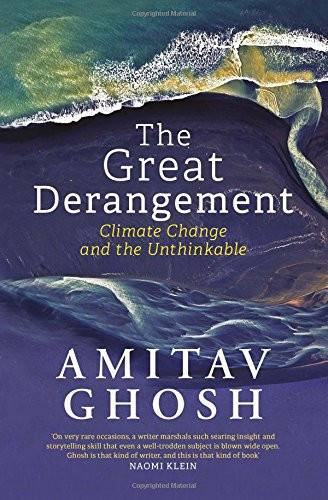
The Great Derangement, by Amitav Ghosh, is an instructive discussion of how the creative imagination interacts with the phenomenon of human-made climate change and it has applicability for Canada. The Great Derangement is this failure in the literary imagination to tell stories that help us make sense of this era of climate change. There are some stark perspectives that are relevant for Canada.
Once in a while you come across a book that you want to tell people about.
We can start with a premiss that we should be aware of how well we tell stories that help us think about our current world and our futures.
That’s what this book, the Great Derangement, is all about. The author, Amitav Ghosh, takes us through the very way we think of our stories, history and politics. Along the way we have a little excitement referring to movies, the novels, and also think about some of the reality of ecological catastrophe of global warming.
Is there a tension with these things? Is the way we tell stories helping?
It is important to face up to the reality that our very way of imagining things may not be adequate for the job of help us understand the vast catastrophe of climate change. The wrong thought patterns, small scope of solutions, little hero narratives, can lead us away from the giant, long-term collective outlook we need.
There’s a real consequence for a place like Canada. A resource-based economy with a colonial past making a transition from oil. We, collectively, have some things to resolve.
The Great Derangement is about our story-telling not being up to the task of helping us make sense of our changing world.
THE MOVIES
A lot of us love those sci-fi disaster movies! Whether its monsters, zombies, aliens, colonies on other planets; what fun.
Remember the Bunch of movies that showed us grizzly Mad Max futures; the trucks, chases and heroes. The other movies where we have visitors from the future, like the Terminators. Or, from other dimensions, Stranger Things!!!.
Some recent advice from author, Amitav Ghosh, however, is that the literary imagination has largely ignored our current REAL circumstances here in the current era of the Anthropocene.
We struggle to tell stories that help make sense of the changing surroundings as they really are. When it comes to the changing weather and sea levels, he says that the literary imagination (novels and stories) is ignoring the biggest change faced by human communities ever.
This “ignoring” is what we can call The Great Derangement
SPEAKING OF MOVIES
Speaking of NOT ignoring a good place to start, there’s a reference to that scene in Star Wars where they are escaping from The Empire spaceships and they hide on a planet. Then our heroes Princess Leia, Chewbacca and Han Solo find out that the planet is actually a monster!
“That is no cave”
A bit of a harbinger, for us today.
Really, for us humans, it has only been a few hundred years since it was widely held that the planet we live on was some kind of living being. A being attached to the gods or whatever. That it would be kind or not; would unleash some tsunami or volcano for vengeance; a drought or flood or storm as “she” wished – unless sacrifices were made.
By the time of modernization, the generations of authors, artists, creative thinkers have given us a narrative about our relationship to the world.
Nature became an outsider. Nature was something to be tamed; even within ourselves. Civilization was about control and conquering the natural world. We made parks, dig for resources for industry and commerce.
Atimav’s book, takes us to the next fold and looks at the emergence of the Human Era, the Anthropocene.
THE HUMAN PRESENCE
In the Anthropocene, human caused changes on the planet will, in turn, make the biggest impact on humanity’s future.
In this era of geological history, humans have had a far reaching, irreversible impact on the planet.
The examples are plentiful. The floods and vanishing lands in Bangladesh. Tornadoes where they did not occur before. There are fires that are incomprehensible large and frequent.
There are “annual” hundred-year storms creeping up and down the coasts.
We can explore where the literary arts has us placed in all of this. From some perspectives we are the rugged individuals, heroes, coping through the disasters (Mad Max, Legend).
Invisible in most of the stories though, we are the collective agents that are causing the changes, and, in real life, we are struggling to discover collective strategies to cope through the disasters and reverse the damage.
This isn’t just man vs nature anymore like grade 8 English class. This is the deeper level of humans influence on the planet, FOREVER, and then the non-human world responding to us and defining our future way of life, FOREVER.
We can try to point to some of the older literature like Paradise Lost, Frankenstein, Moby Dick, King Lear. History has lots of literary references to the power of nature.
The current literary directions, though, didn’t use those as taking off points when it comes to understanding the current weather.
We have the stories of individual sailors, adventures or pioneers in the north or on the sea. These don’t do much to help us understand this vast long-term collective crisis we are in.
LITERATURE BECOMES CONCEALMENT
Modern literature becomes a concealment that prevents people from recognising their reality.
The novel – as literary form – came to exit precisely during that era when humans were harnessing the energy of coal and then oil and changing the world forever.
The author tells us that instead of preparedness or an understanding of the world around us, Anthropocene literature, especially realist literature, has emerged as a kind of concealment.
When the future comes and they take a look at what we’ve written, the author asks, “will it be the case that ours was a time when most forms of art and literature were drawn into the forms of concealment that prevented people from recognizing the realities of their plight?”
This is when we can understand as the era of the Great Derangement
The Great Derangement is that humans have become geological agents but have failed to use their imaginations to explore and prepare for this.
EXPLAIN THIS POINT
There are a few ways Amitav explains this part to us:
The first part of the explanation is about imagination and the believable.
Literature helps us understand the world by making sure stories are believable. Novels in particular are built on the scaffolding of exceptional moments across some kind of landscape that is otherwise very believable. We can all understand this. That’s what makes the stories so exciting.
In the world of novels, we build places that can be believed. The conditions in the story have to reflect the everyday enough for us to suspend disbelief.
The believability of story forms is so present that we can also say truth is stranger than fiction.
The Anthropocene is a difficult place for the imagination. We are in an era where the unimaginable weather and global sea rise is the MOST likely future and the continuation of the present weather is the LEAST likely.
Now we might be able to see that fiction – as we know it – has no place to go when our reality gets incomprehensible.
This contradicts one of the central tasks in story-telling; to make things believable with some exceptional moments.
The Anthropocene turns this on its head because, in the Anthropocene, everything is exceptional and nothing is believable.
The second part of the explanation has to do with the priority of the individual over the collective.
We can take a look here to see how the novel/fiction deals with themes of the individual rather than the collective. The era of global warming has the whole world much smaller in some ways. What happens on the other side of the world is intimately tied to our own experience and behaviour. We can use this observation to point to some limitations of the novel form. The novel relies on stories from (usually) individual protagonists and their own heroic journeys.
This does not transition well to the situation when the adventure is global and consequences are community-centric rather than individual.
We can quite imagine how this works with a little mental experiment. For example, how can climate justice – as a concept – be narrated in a story? The real scale and violence of it all passes our understanding. The story spans generations, continents, and economic ways of life, yet still ties people tightly together in the same battles with the same floods and fires and relocations all the with same causes.
The collective experience may have a new priority to help our understand. We have not yet seen the collective as a large priority in modern storytelling.
Finally, there is the area of intimate connections over vast distances.
A person can spend a good amount of time talking about migrations due to weather conditions. These are part of the current and future reality around the globe. Even those that want to downplay global warming consequences will agree that there will be migrations from coastal communities due to sea-level rise. Its just a matter of how much and how soon.
The Anthropocene is about forces that are hard to understand, insistent and inconceivably vast. Events from British Columbia to Bangladesh are of the same origin in these times. From Singapore to London… we are joined in the experience of the same phenomenon and will struggle for joint solutions.
“…forces of unthinkable magnitude that create unbearably intimate connections over vast gaps in time and space.”
Atimaiv puts it: “For most Governments and politicians, as for most of us individuals, to leave the places that are linked to our memories and attachments, to abandon the homes that have given our life roots, stability, and meaning, is mothing short of unthinkable”
This is at a time when global warming has become a global and collective predicament
The priority for addressing the vast connections across time and space has not yet had a place in the novel form.
Moving on from the limitations of the novel form and storytelling, Amitav Ghosh addresses history and politics in the imagination.
COLLECTIVE HISTORY
Global warming is a product of all human activity over time. We are at once ALL responsible and at the same time NOT equally responsible. Rich countries burned more oil for longer.
In the broader discussion through, the lens of empire and imperialism, there’s a special focus on Asia given the history and recent developments as they apply to the scale and urgency of climate change. For sure the use and control of fossil fuels are connected to power and empire. The clear examples for this is with everything from the spinning jenny, to steam engines, to ship building. So it goes; power follows wealth and in the modern era, wealth follows control of fossil fuels.
There are massive global equity and reparations issues associated with this.
On the topic of history, the Great Derangement is that “our choices are framed in a pattern of history that seems to leave us no where to turn but toward our self-annihilation”
… until we can imagine things differently!!!!
CANADA LINKED TO THE WHOLE WORLD
Canada is a significant contributor, and historical contributor, to green house gases. We are one of the worst, per-capita in the world and we have been for a long time which means we are way past our share.
We are locked into some important post -colonial reconciliation work that is intertwined with elements of climate change activities. Think of the Idle-No-More activism, anti-pipeline protests, land rights and old growth forest preservations to name a few.
It is the wicked story of the Canadian experience that combines these threads. The work to come to terms with post-colonial reality is… the Canada experience. Also, the very basis of our economic history as belonging to global power alliances and extractive industries that is also the Canada experience.
Increasingly, so this lesson from Amitav Ghosh goes, it is INEVITABLE that Canada will deepen its connection to the collective global exercise of addressing climate change.
Either this or we are on the path to deepen our role in the Great Derangement.
In the category of sometimes heading things off with a question; Have we built the storytelling to imagine all the ways that Canada is linked to its past and to many other places in this era of climate change?
POLITICS: LITERATURE AS Avant-Garde
The last section of the book is on how we imagine politics: He uses THREE ways to explain this area.
POLITICS AND THE AVANT-GARDE provides an interesting perspective of the arts through history as being “…stance of unyielding rage against the current order”.
We can see that ALL through the modern era literature was the harbinger of new ideas and freedoms. Afterall, arts has a long long history of being ahead of its time; the avant-garde. Fiction writers risked life and limb to tell the great stories. The stories that emasculated the powerful, freed our minds, prepared us for the struggles against religious tyranny and fascism and brought in ages of new critical thinking.
Writers were all onboard with being avant-garde for fear of being left behind. The author Ghosh, in his understanding, sees many artists and writers now going “off in all directions: as if for cover and self-preservation in the Anthropocene.”
A second line of thinking is to see literature as an accomplice in the great derangement.
The novels can centre around “individual moral adventure” with a big concern for stories about a protagonist’s own journey’s and self-discovery. In the society of the individual spectacle, there is a risk of entirely missing the experience at hand in the present, that is largely about humans as a collective.
It is nearly impossible to reconcile individual spectacle and global climate change collective activism.
For much of the time now, the artist may be part of the collusion for this era during the Anthropocene. We spend time escaping into small story rather than grappling with the real scale of events all around us.
People will always want to find meaning and purpose in their lives. This is where writers and creators become really important. In the absence of well-developed imagination for meaning and purpose, the denialists and cynics will find a space.
We might suppose that the future may “hold artists and writers to be equally culpable… for the imagining of possibilities is not, after all, the job of politicians and bureaucrats”
Denialism (especially as it occurs in partially anglo-countries like Canada) is motivated by attempts to find meaning in their history, and even their cultural existence in the world. Meaning takes good imagination. Without it, there’s cynicism.
Finally, we are taken toward a politics of the armed life-boat.
There are a lot of society divisions relating to global warming and environmentalism, especially in places like Canada. In effect, climate change is a kind of threat multiplier that makes existing divisions even worse.
In politics, the Great Derangement is the dangerous bargain of trying to maintain the status quo when this is impossible. The inadequacy of our story telling has led to a feeble political responses across the political spectrum. There is a focus on the individual, short sighted commercial thinking and abandonment (or cynicism) of public institutions and international agreements and actions that are so obviously necessary.
The status quo of the weather is absolutely unlikely and maintaining any level of status quo for industry and global relations would only be able to be accomplished by force and would inevitably lead to our own annihilation. The consequence is what we can call “the armed life boat.”
In Canada’s case, the velvet glove of ineffective policy for ending oil production on the oilsands, for example, is really a disguise for the steal hand that would lead us toward a future of the armed life boat. In the face of rising seas, displaced populations a continuation of a fossil fuel economy can only be possible with a massively expanded military burden (either here at home or abroad or both).
The continued belief that things can or should stay the same — is part of the Derangement
BACK TO THE MOVIES: SORCERER’S APPRENTICE
Well, back o the MOVIES for just a second. The author took us through how these climate change events are of our own making, to greater and lessor degrees, and so this work of our own hands is returning to haunt us in unthinkable ways.
It is regrettable that the author did not make any reference to that old Disney movie, The Sorcerer’s Apprentice. It is definitely the image that can be pulled up.
I remember so clearly seeing it as a little kid and being that scared when things were getting out of control. The flooding, the persistent army of brooms, the floating spell-book and the swirling waters!!
Maybe the sorcerer who rescued mickey mouse in the end, is like our own imaginations pushing us to cooperative planning, strengthened institutions, and global agreements.
Here’s to imagining anyway!
FOOT NOTE….His proof is that while through the recent years… there’s proof on the web everywhere that there is concern for climate change EXCEPT for fiction and the arts – if you look at shortlists for prizes, reviews and so on. There, there is not much of a sign of a heightened concern for climate change.
FOOTNOTE He puts a small aside that is a little like proof by exception. It is telling that when novelists do turn to write about climate change – the fiction genre is abandoned, and they choose TO WRITE IN non-fiction form. His example is Arundhati Roy
Ghosh, A. (2017). The great derangement. University of Chicago Press.