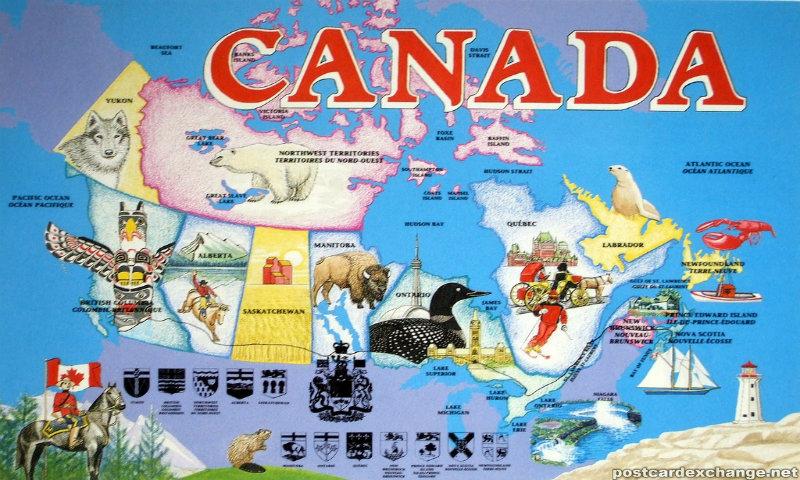
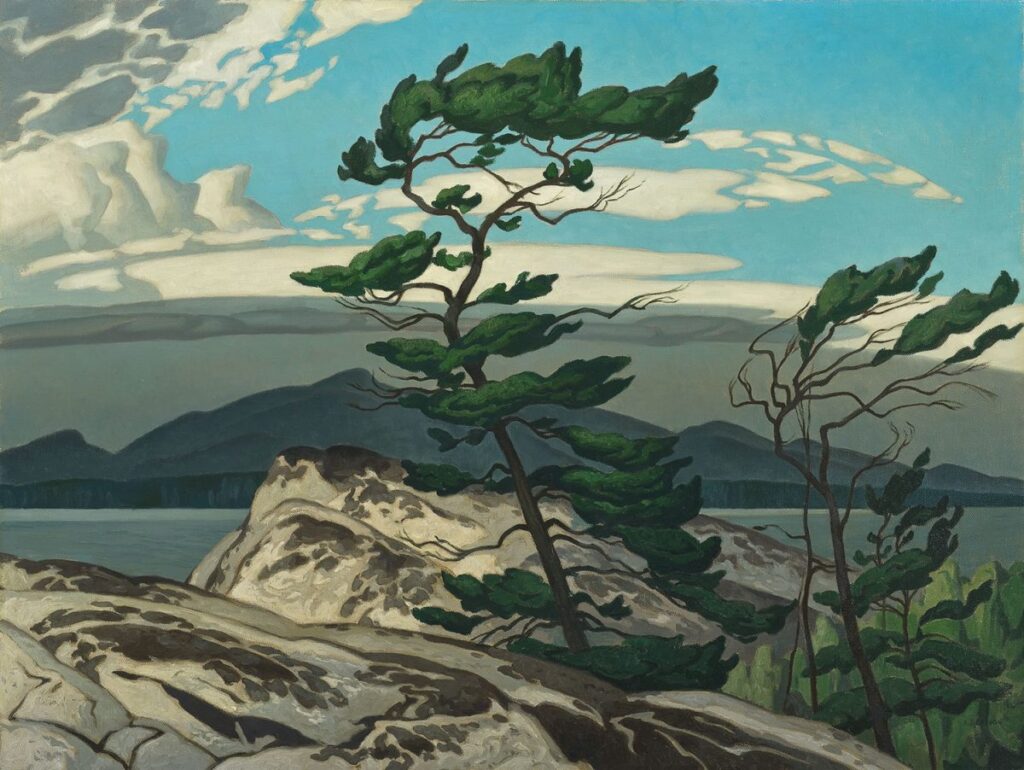
The persisting Canadian public opinion on the environmental reflects deeper aspects of Canadian identity and can be leveraged to build awareness of Canada’s actual record on the environment and advocate for more assertive climate change policy directions
There was this time back in the day when you felt like you could just walk through an Emily Carr painting. Ahh see the honourable huers of wood and drawers of water! Those lonely and courageous folks on these rugged shores of North America’s expanse. Lawren Harris with his cartoon mountain dancing in the sunshine. The folksinger greats lamenting about loss and cold and the icy relentlessness.
This is that old great white norths tuff. The Milne painting of the snowy valley, Morrisseau and the woodlands school. Even way back to the Krieghoff with the kids playing hockey on the pond.
BUT WAIT!!!!
These paintings that can seem to depict a way of life, a sensibility or national perspective. really fall short of the reality of who we actually are.
Really, Canada is an oil extraction GIANT villain, one of the worst CO2 emitters in the world!
The huge part of our whole civilization is funded directly from the nature destroying extractions industries.
GAP BETWEEN PUBLIC OPINION AND PUBLIC POLICY
There’s a story here. There is a sharp tension between what Canadian opinion is concerning the environment and the reality at the economic activity level.
Opinion surveys shows that Canadians overwhelmingly believe in climate action and a fossil fuel transition and yet our policy-makers continue to allow worsening emissions performance (way out of step with the rest of the world).
This should help us know there’s room to advocate for more climate action from our governments.
WHO’S AFRAID OF CANADIAN CULTURE
Who can’t be taken by that provocative title of Susan Crean’s piece back 1976, Who’s Afraid of Canadian Culture? The piece was really put together when people had their doubts about whether or not Canadian identity was a coherent anything. If it existed or would ever amount to anything at all. Well maybe it was a bit elusive at the time to think of a unique and sustaining set of cultural values that could bind us across this big diverse, often empty-looking place called Canada. Maybe we know a bit more about this today! We can see in front of us the identity-bearing fine art, music, novel writing. There’s also… well… the OPINIONS we have together about our experience and outlook.
Crean’s book forces the conversation a layer deeper on this “opinions” point. Maybe about our aspirations about where we live and what we do. On the topics of climate and fossil fuels, for example, do Canadians have a particular public opinion outlook? A look at public opinion survey information can get us a picture.
CANADA PUBLIC OPINION DATA
There is a long string of polls that show support for government addressing Climate Change and investing in the environment.
The surveys show a very large majority of Canadians are seriously worried about climate change (over 75%). Three-quarters of us are now making the connection between extreme weather and global warming. The public is now broadly convinced that an energy transition is inevitable (71%) and is highly supportive of shifting to clean energy (81%).
There’s more. In the area of carbon pricing? most Canadian support it. Over 70% support carbon pricing. And for things like electric cars, over 70% support federal incentives for EVs
Canadians overwhelmingly understand that the energy transition is a global phenomenon, not something we only talk about in Canada. Three-quarters believe it will be beneficial in the long term and 70% say that it’s necessary “whether we like it or not.” These results hold even though 59% think it will make their life more expensive. And even further to the point about what polling results ranged from 42% to 57% saying the government is not doing enough to spur a clean economy or combat climate change
This would be interpreted by just about anybody as strong support on any issue. But turning this perspective on the environment into action is another thing entirely.
People say they want clear action on the environment. So why are governments still allowing GROWTH in fossil fuel extraction??
There is a huge gap in the business of connecting actual public opinion to actual public policy.
Paul Burstein, University of Washington takes a look. He reviewed over 30 different studies to try to understand the link between policy and opinion and answer questions like, “does public opinion actually impact on policy?” and “what is the role of special interests?”
The research looked across a set of studies and reviewed factors like how important certain issues were to people as well as the role of media and special interest groups.
THE FINDINGS
Surprisingly, the conclusions were that:
- public opinion was the strongest of the influences for policy change
- The relative amount of influence was affected by how important (salient) the issue was to the public
- the impact of special interests was varied and perhaps influenced by the priority (salience) of the issue.
THE REALITY ….
The record on the environment here is Canada, is clearly is NOT one about “peace order and good government”.
Canada’s oil and gas sector is the largest single emitter of GHG accounting for 26% of emissions.
(NOTE even THAT is not the whole story because it does NOT account for scope 3… where the exported fuels are actually burned… look out for a future pieces on scope three emissions)
The gap between opinion and actually policy is a price paid in a natural resources-based economies. From fisheries to coal and timber, WATER WAYS, and mines; the very foundations of the economies across Canada are about extraction. The record for how these impact on the environment – is probably based described as a very very strong contributor to the climate emergency.
There are BILLIONS AND BILLIONs in oil extraction activities happening in Canada. The plans at the federal and provincial levels are to continue or increase oil production for the foreseeable future.
Government inaction is out of step with opinion
Surveys show we want emissions in Canada to go down. Actually, they are going up AND the current plans are to have them continue to go up.
Surveys also show that we aspire to better performance / leadership than other OECD neighbours. The exact opposite of this is happening.
The majority of Canadians want measures to either slow down or cancel oil exploration. Actually, under the current measures from Canada energy announcement, the opposite is happening. There is more exploration and expanded production being planned.
PLACE FOR ADVOCACY
We all continue work in the business of advocacy to close the gap between the opinions we hold and the policies our governments put in place.
There is a very telling finding in one of the surveys, that… “Canadians are not convinced that we can get climate change under control and this perspective has serious implications for building a constituency demanding more action.”
The obvious question is. what would it take for policy to move in the right direction on this?
If we look to the past, then the answer may have something to do with continued, sustained, strong, active public opinion. It’s not easy. There’s work to do. It’s up to us constituents
Let’s help policy-makers NOT make us into huers of wood and drawers of oil to help some billionaires sell oil (exceed science-based global carbon budgets).
Skipping the hyperbole, at least we should be able to expect that public policy reflect public opinion on these things that matter to us most
NOTES
I’m making fun ironic use of the title from Crean’s book – actually the book was counter to the idea of a unified national level culture at the time… not exactly an opposite intention, but…
“cultural decentralization is advocated as a more genuine solution to the problem of rendering an indigenous flavour and autonomous nature to Canadian cultural accomplishment. In this way, local and regional touring of artistic activities and community cultural exchanges can act as more effective complements to national developments.”
References
- https://clean-climate-communities.document360.io/docs/what-do-canadians-think-about-climate-change
- Federal government recently announced to boost green buildings
- https://www.ctvnews.ca/climate-and-environment/federal-government-unveils-1-5-billion-plan-to-boost-green-building-1.5387330
- https://media.wnyc.org/i/1200/627/c/80/1/canadamapcheesy3_MtISu58.jpg
- What do Canadians Think about Climate Change? From “Clean Climate”.
- The Impact of Public Opinion on Public Policy: A Review and an Agenda”
- Title painting By AJ Casson, Canadian Art Collection